
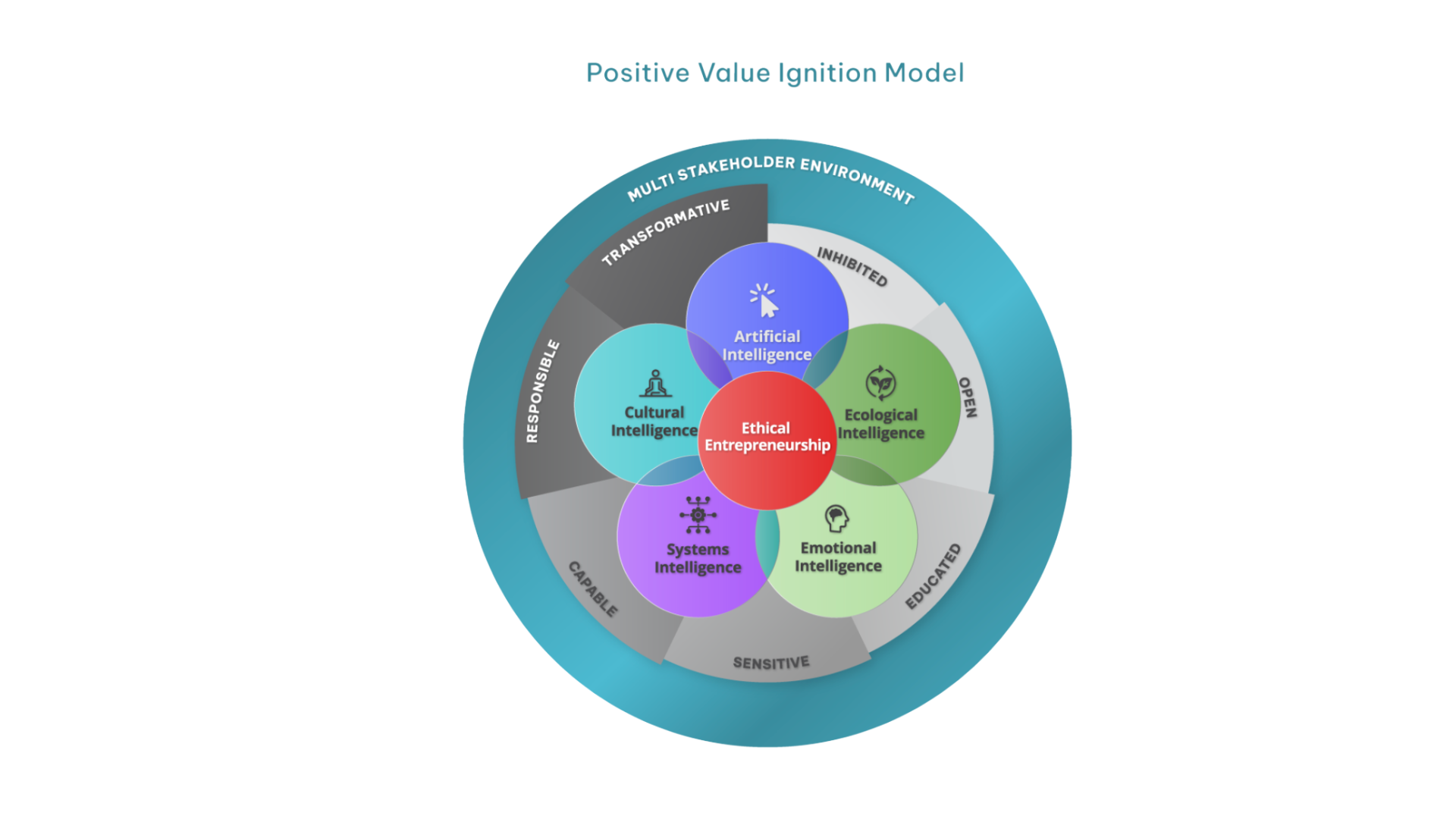
At the intersection of artificial intelligence, sustainability, and global supply chains lies an immense leadership challenge. The Positive Value Ignition Model offers coaches not just as a theoretical framework but as a practical coaching tool for developing leaders’ ability to confront this complex landscape. Its power lies in its ability to integrate multiple dimensions of leadership whilst remaining adaptable to diverse contexts and roles. The coaching process begins with a fundamental recognition: today’s leaders face challenges that can’t be addressed through traditional, siloed approaches to development. Whether working with a supply chain executive grappling with AI integration or a policy maker designing regulatory frameworks for critical minerals, coaches must help leaders see and influence entire systems rather than just their component parts. Initial engagement starts with deep exploration. Coaches guide leaders through a comprehensive mapping of their current capabilities across the six intelligences and four environmental dimensions. This isn’t a simple assessment exercise—it’s a journey of discovery that helps leaders understand how their capabilities interact and influence their effectiveness in handling complex challenges.
Through structured conversations about real challenges, coaches help leaders identify patterns, recognise interconnections, and understand how different aspects of their leadership style impact outcomes. The development process moves beyond traditional coaching approaches that focus on individual skills or behaviours. Instead, coaches help leaders develop integrated capabilities that allow them to navigate complexity whilst creating sustainable value. This might involve helping a technology leader understand how their AI development decisions affect community resources, or guiding a supply chain executive in balancing efficiency with environmental impact. Cultural intelligence becomes particularly crucial in this context. Leaders must deal with an increasingly complex web of stakeholder relationships spanning different cultures, value systems, and expectations. Coaches help leaders develop the sensitivity and skills needed to turn this diversity into a source of strength rather than a challenge to be managed.
For leaders in technical roles—whether engineers developing new AI architectures or supply chain executives implementing automation—the coaching process helps bridge technical expertise with broader leadership capabilities. This isn’t about diminishing technical knowledge but about placing it within a larger context of stakeholder needs, resource constraints, and ethical considerations. A semiconductor engineer, for instance, might receive coaching on how their technical decisions about chip architecture affect not just performance metrics but also energy consumption, manufacturing complexity, and ultimately, global resource allocation. The coach helps them see these connections and develop solutions that balance technical excellence with broader system impacts.
Policy makers and academics find particular value in how the model bridges theoretical understanding with practical application. When coaching these leaders, the focus shifts to how research and policy can create real-world impact whilst considering complex system dynamics. A policy maker developing AI regulations, for example, receives coaching on how to create frameworks that enable innovation whilst protecting societal interests and ensuring sustainable resource use. The coaching process employs a wide set of tools and techniques designed to help leaders face complexity. Through systemic questioning, leaders explore the interconnections between different aspects of their challenges. Scenario exploration helps them understand potential futures and develop adaptive strategies. Reflection practices enable deeper learning from experience, whilst action learning projects provide opportunities to apply new insights in real-world situations.
Most importantly, the coaching process focuses on helping leaders create sustainable impact. This means going beyond immediate performance metrics to consider long-term value creation across multiple stakeholders. Coaches help leaders understand how their decisions affect different stakeholders, how these effects propagate through systems, and how to create solutions that generate positive impact whilst managing potential negative consequences. For both coaches and leaders, the model provides a framework that evolves with experience. Regular reassessment ensures that development remains relevant to changing circumstances. Adaptation allows for new learning to be integrated, whilst impact assessment helps track progress and identify areas for further development.
In the context of supply chain leadership, this evolving approach is particularly valuable. Supply chain leaders must constantly adapt to new technologies, changing resource constraints, and evolving stakeholder expectations. The coaching process helps them develop the capabilities needed to navigate these changes whilst creating sustainable value. For blue ocean strategists and innovators, the model offers a way to ensure that new value creation opportunities consider both technological possibilities and systemic implications. Coaches help these leaders explore how innovations can create positive impact across multiple stakeholders whilst remaining within resource constraints. Engineers and AI leaders find in this coaching approach a way to bridge their technical expertise with broader leadership capabilities. The process helps them understand how their technical decisions ripple through social and environmental systems, enabling them to create solutions that are both technically excellent and systemically beneficial.
This coaching framework represents a fundamental shift in how we develop leaders for complex challenges. By integrating multiple dimensions of leadership whilst remaining adaptable to specific contexts, it provides a pathway for developing the leaders we need for an increasingly complex future. Whether working with supply chain executives, technical leaders, policy makers, or academics, the model offers a structured yet flexible approach to building the capabilities needed for sustainable value creation in our interconnected world. The coaching practice is an integral part of the value proposition the team at Elephants in Main Street offer its clients. It forms the backbone building the strategic leadership capacity for individuals and teams in organisations to tackle critical climate-related issues and sustainability. We do this through the implementation of multidirectional cognitive experiential turning points which are delivered to clients and their stakeholders. These processes enable leadership in organisations to strategically engage with their people and stakeholders and ensure that policy leadership groups for collective action thrive and effectively deliver on their mandates.



Leave a Reply